
How GPS Time Tracking Eliminates Payroll Disputes for Contractors
Payroll disputes cost contractors time, trust, and money. GPS time tracking removes the guesswork, here's how it works and why it matters.

Payroll disputes are one of the most uncomfortable conversations a contractor can have. Someone thinks they worked 10 hours. Your records say 8. Nobody's lying, or at least, nobody can prove anyone is. The only result is friction, resentment, and a slow erosion of trust on your crew.
GPS time tracking doesn't eliminate every problem in your business. But it does eliminate this one entirely. When clock-in and clock-out events are tied to a verified location and timestamp, there's nothing to argue about.
Why Payroll Disputes Happen in the First Place
Most payroll disputes aren't about dishonesty. They're about ambiguity. Paper timesheets are filled out from memory, sometimes at the end of a long day, sometimes days after the fact. Honest people misremember. They round up. They forget the 20-minute lunch break they took or add back the 15-minute delay waiting for a delivery.
The problem compounds when your records don't match theirs. You have a paper form that says one thing; they remember something different. Without a third source of truth, it becomes a standoff. And in a standoff, someone always leaves feeling cheated.
The underlying issue isn't the workers. It's the system, or the lack of one. Paper timesheets require too much trust in human memory, and human memory is unreliable by design.
How GPS Time Tracking Works
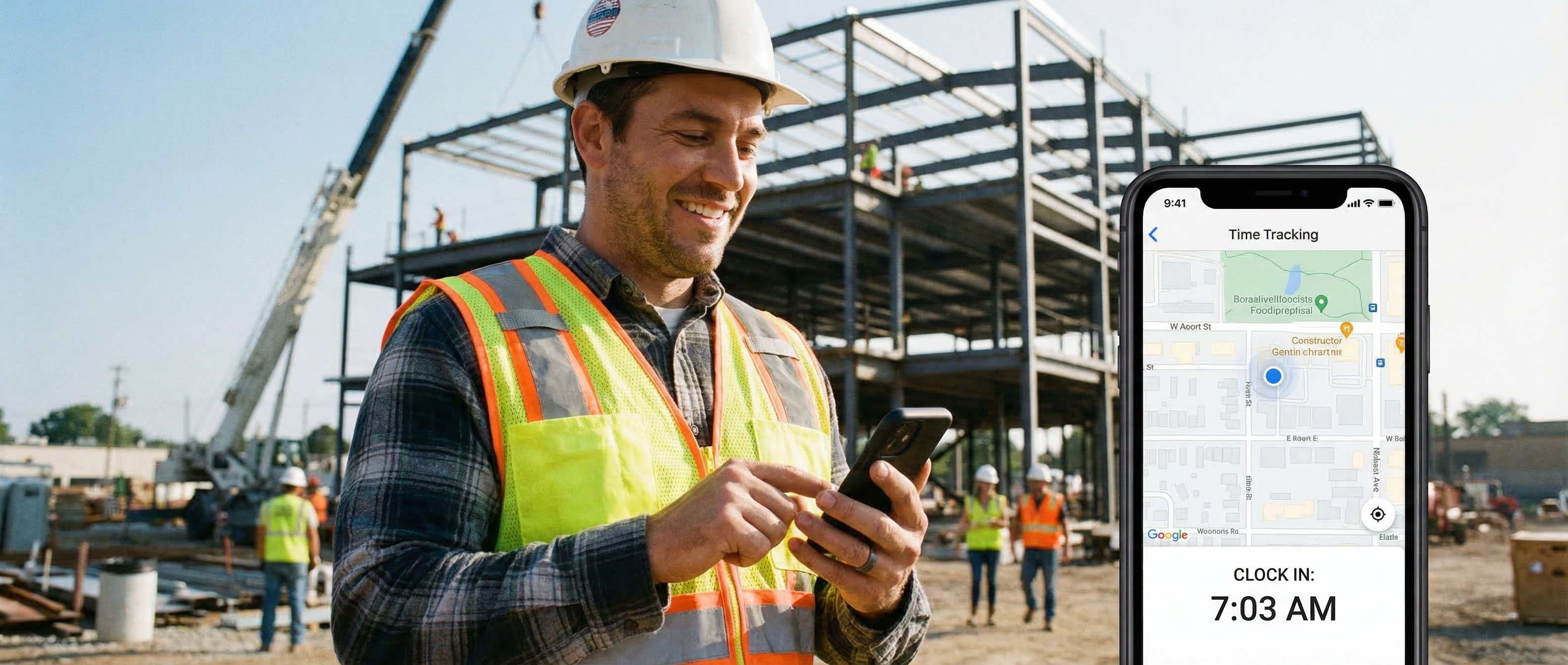
GPS time tracking ties clock-in and clock-out events to a physical location and a precise timestamp. When a worker arrives at the job site, they check in on their phone. The app records where they are and when, not what they estimate, not what they remember. What actually happened.
That data syncs to the office automatically. No one needs to collect timesheets, transcribe handwriting, or chase down missing forms. By the time you're building payroll, every hour is already accounted for with a location stamp and a time stamp attached.
Geofencing adds another layer: You can define a radius around each job site. The app can automatically flag or prevent check-ins that happen outside that radius, so there's no ambiguity about whether someone was actually on site when they say they were.
The Dispute That No Longer Exists
When a worker says "I was there until 5:30" and your GPS data shows a check-out at 4:55, the conversation changes completely. You're not questioning their honesty. You're looking at a record together. Maybe they forgot to check out. Maybe there's a data issue worth investigating. Either way, you're working from facts, not competing memories.
More often than not, having the data prevents the dispute entirely. Workers know the hours are being tracked automatically. They're not trying to pad timesheets, they just want accurate pay for actual hours. When the system is reliable, most people trust it.
The contractors I've talked to who switched to GPS time tracking consistently report the same thing: the first few weeks feel like an adjustment, and then payroll just... stops being a source of conflict.
What You Gain Beyond Dispute Resolution
Eliminating payroll disputes is the most visible benefit, but GPS time tracking changes how you run jobs in other ways too.
Accurate job costing: When you know exactly how many hours were spent on each job, you can compare actual labor costs to your estimates. Over time, that data makes you a better bidder. You stop underquoting jobs that consistently run long.
Overtime visibility: You can see in real time when workers are approaching overtime thresholds, before the hours are already gone. That gives you room to adjust assignments rather than just absorbing the cost after the fact.
Accountability without micromanagement: The data is there if you need it, but you don't have to actively monitor anyone. Workers know the system exists. That knowledge alone tends to tighten up habits, not because people are dishonest, but because it removes the ambiguity that creates bad habits in the first place.
Common Objections (And What I've Seen in Practice)
"My guys will resist it." Some will push back initially. But workers who care about being paid accurately tend to come around quickly. The ones who resist longest are usually the ones who've been benefiting from the ambiguity, and that's worth knowing.
"It feels like surveillance." It's worth being direct with your crew about what the app tracks and what it doesn't. GPS time tracking records when and where they clocked in and out. It's not tracking their lunch break, their drive time, or their personal phone. Framing it correctly from the start makes a big difference in how it lands.
"What if the GPS is wrong?" Modern GPS accuracy in built-up areas is typically within 5–10 meters. For job site check-ins, that's more than precise enough. Edge cases exist, working in a basement, signal issues in remote areas, and any good system allows manual overrides with a supervisor note.
The Bottom Line
Payroll disputes are a symptom of a broken data system, not a character flaw in your workers. When your records are automatic, location-verified, and immediately accessible, the disputes stop because there's nothing left to dispute.
JobBuddy's GPS time tracking was built with this in mind: simple enough that workers actually use it, reliable enough that you trust it, and detailed enough that payroll becomes straightforward. If Sunday nights mean reconciling timesheets instead of preparing for the week ahead, that's the part worth fixing first.