
How GPS Time Tracking Reduces Payroll Disputes for Contractors
Payroll disputes drain contractor businesses more than most owners realize. Here's how GPS-based time tracking cuts through the gray areas, and keeps everyone accountable.
The argument happens on a Friday afternoon.
A worker says he was on site by 7:15. You've got him clocked in at 7:45. Neither of you is lying, not exactly. But someone's memory is wrong, and now you're both frustrated, the week ends on a sour note, and somewhere in the back of both your minds, a little bit of trust just eroded.
Multiply that by ten workers, fifty jobs a year, and the occasional dispute that turns into a real problem, and you've got one of the most persistent, low-visibility drains on a contractor business.
GPS time tracking doesn't just speed up payroll. It largely removes the dispute in the first place.
Why Disputes Happen in the First Place
Payroll disputes aren't usually about dishonesty. They happen because the systems most small contractors use, paper timesheets, phone call check-ins, end-of-day text messages, rely on human memory. And human memory is unreliable under pressure.
A worker filling out a paper timesheet on Friday afternoon is reconstructing the week from memory. They're going to round up on the days that ran long. Not because they're trying to steal, because that's how memory works. They felt like they worked hard, so they probably got there earlier than the sheet says.
On the owner side, it's the same problem. You're doing payroll based on incomplete data. You weren't on every site. You can't verify the times. So you either approve things you're not sure about, or you push back and create friction.
Neither outcome is good.
What GPS Tracking Actually Provides
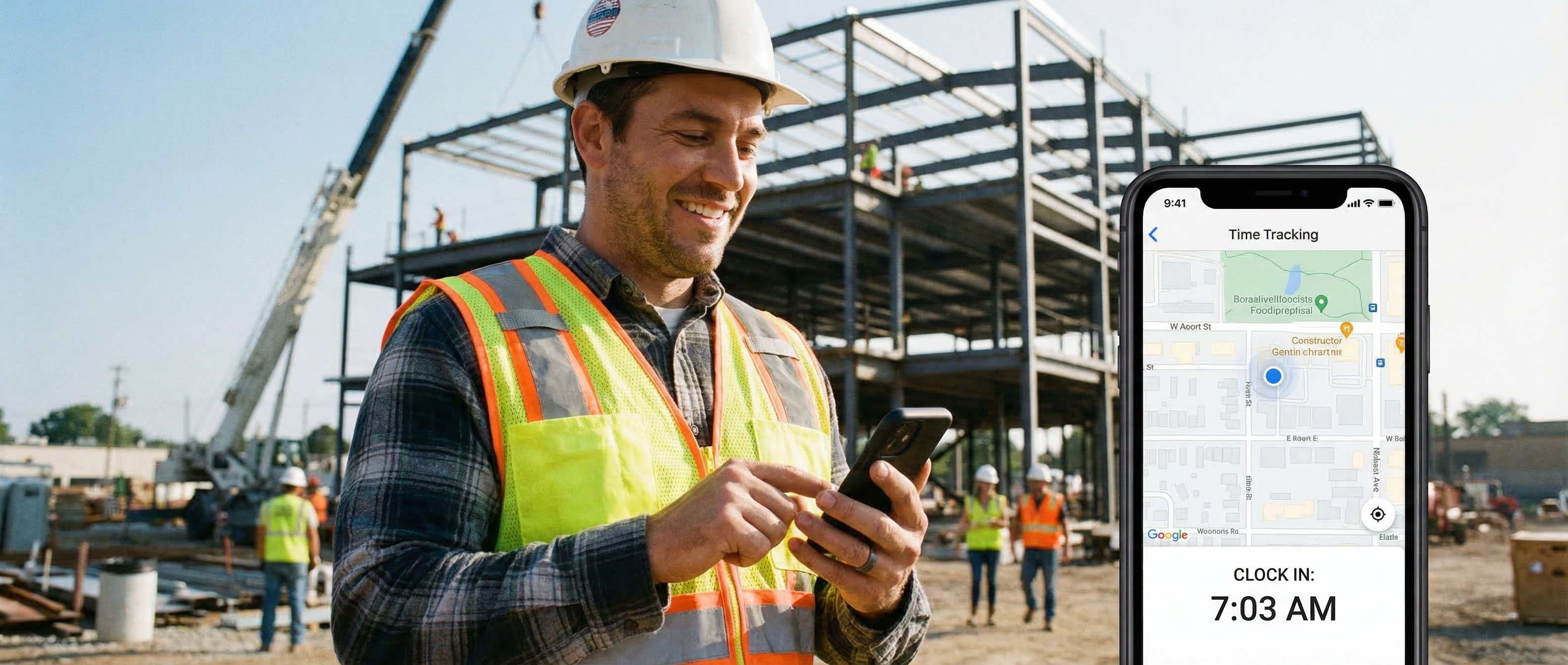
When workers clock in and out through a GPS-enabled app, the record isn't based on memory. It's based on location and timestamp.
Location verification. The system records where the worker was when they clocked in, and flags if that location doesn't match the job site. No more "I was on my way" time counting as on-site time.
Automatic timestamps. The clock-in time is exactly when the button was pressed, from exactly where the worker was standing. There's no reconstruction. There's no rounding. There's a record.
Audit trail. When a dispute comes up, and they still will occasionally, you have something to look at. Both parties see the same data. That alone changes the conversation from "my word against yours" to "here's what the app shows."
That shift in framing matters more than most contractors expect.
The Behavior Change Is the Real Win
Here's something contractors don't talk about enough: GPS tracking changes how workers behave before any dispute ever happens.
When everyone knows that clock-in times are tied to location, the incentive to fudge them disappears. Not because your workers are dishonest, but because the system doesn't leave room for ambiguity. The "gray area" where disputed time usually lives just gets a lot smaller.
Workers who are actually on time every day have nothing to worry about. Workers who've been fudging their times, even slightly, stop doing it because the system now makes it obvious.
You end up with cleaner data across the board. Payroll runs faster. Disputes get rarer. And the ones that do come up get resolved in minutes instead of stretching into the next week.
What to Look for in a GPS Time Tracking System
Not all GPS tracking tools are built for how contractors actually work. Here's what matters in the field:
Works offline. Job sites don't always have reliable cell service. If the app stops working without internet, it's useless in the field. You need something that captures time and location locally, then syncs when connectivity returns.
Simple enough for every worker to use. If the app is complicated, workers won't use it consistently, and inconsistent data is worse than no data. The clock-in flow should be three taps or less.
Job-based tracking. You don't just want total hours, you want hours per job. That data feeds directly into job costing, so you can start seeing which jobs are actually profitable and which ones are quietly eating your margins.
Photo documentation support. Some disputes aren't about when someone showed up, they're about what got done. An app that links photos to job entries gives you a full picture of the day's work, not just the hours.
It's Not About Surveillance
One thing contractors sometimes worry about: will workers push back on GPS tracking? Will they feel like they're being watched?
In practice, the reaction is usually the opposite. Workers who show up on time and work hard love that it's being tracked. They're tired of working alongside people who get paid the same for doing less. A system that records actual time is a fairness tool, not a surveillance tool.
Frame it that way when you roll it out. "We're tracking time so everyone gets paid accurately and nobody can claim you weren't there when you were." That message lands differently than "we're watching you."
Your best workers will appreciate it. And the ones who've been taking liberties with their time will either get honest or get gone, both of which are fine outcomes.
The Broader Payoff
Fewer disputes is the obvious win. But the downstream effects are just as valuable.
When your time data is accurate, your labor cost tracking gets accurate. You can see what jobs are really costing you in hours. You can catch jobs that are going over budget before it's too late to do anything about it. You can price future jobs more accurately because you're working from real data, not estimates based on gut feel.
That's what GPS time tracking actually buys you: not just fewer Friday afternoon arguments, but a business that runs on facts instead of approximations.
If payroll still feels like a guessing game at your shop, it doesn't have to.